
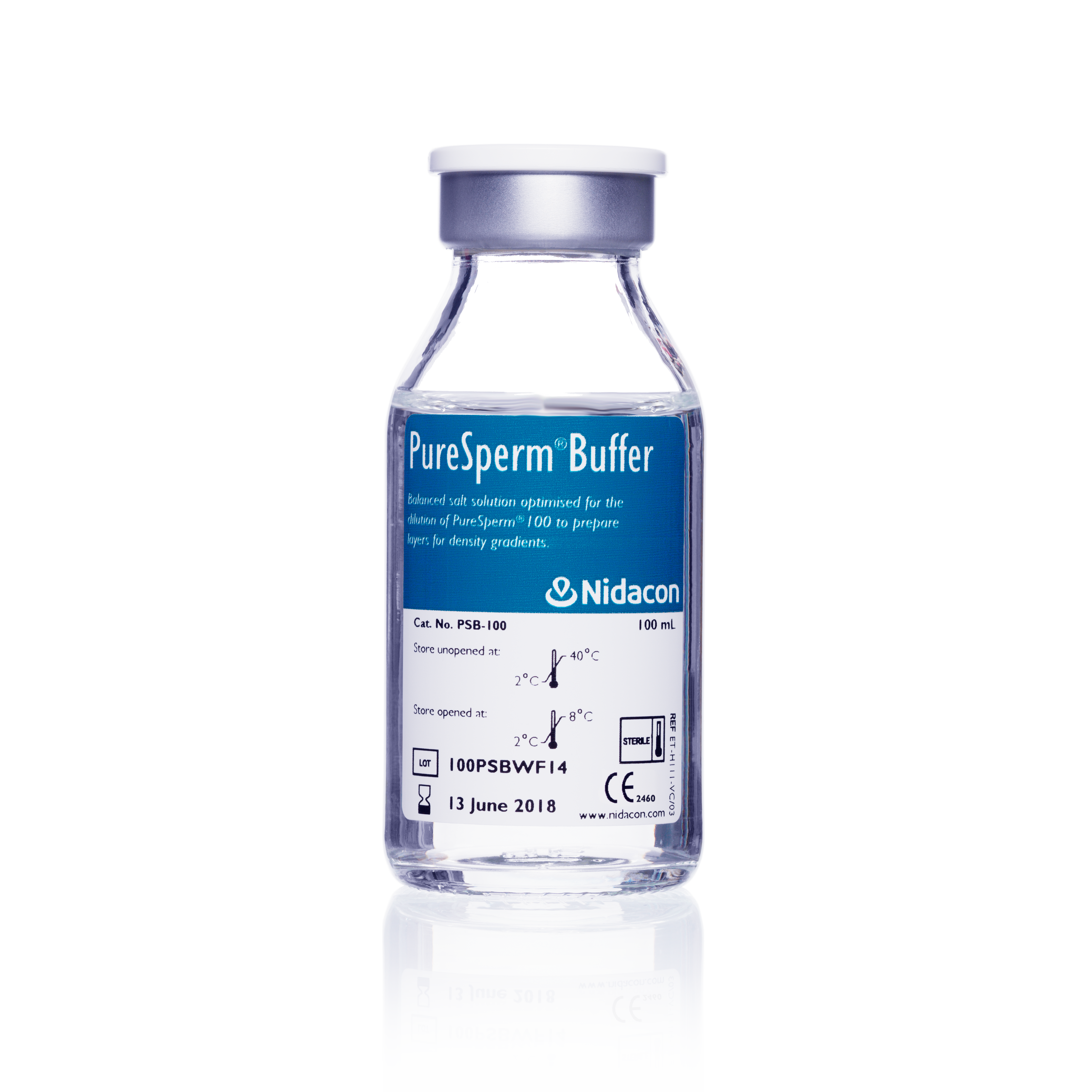
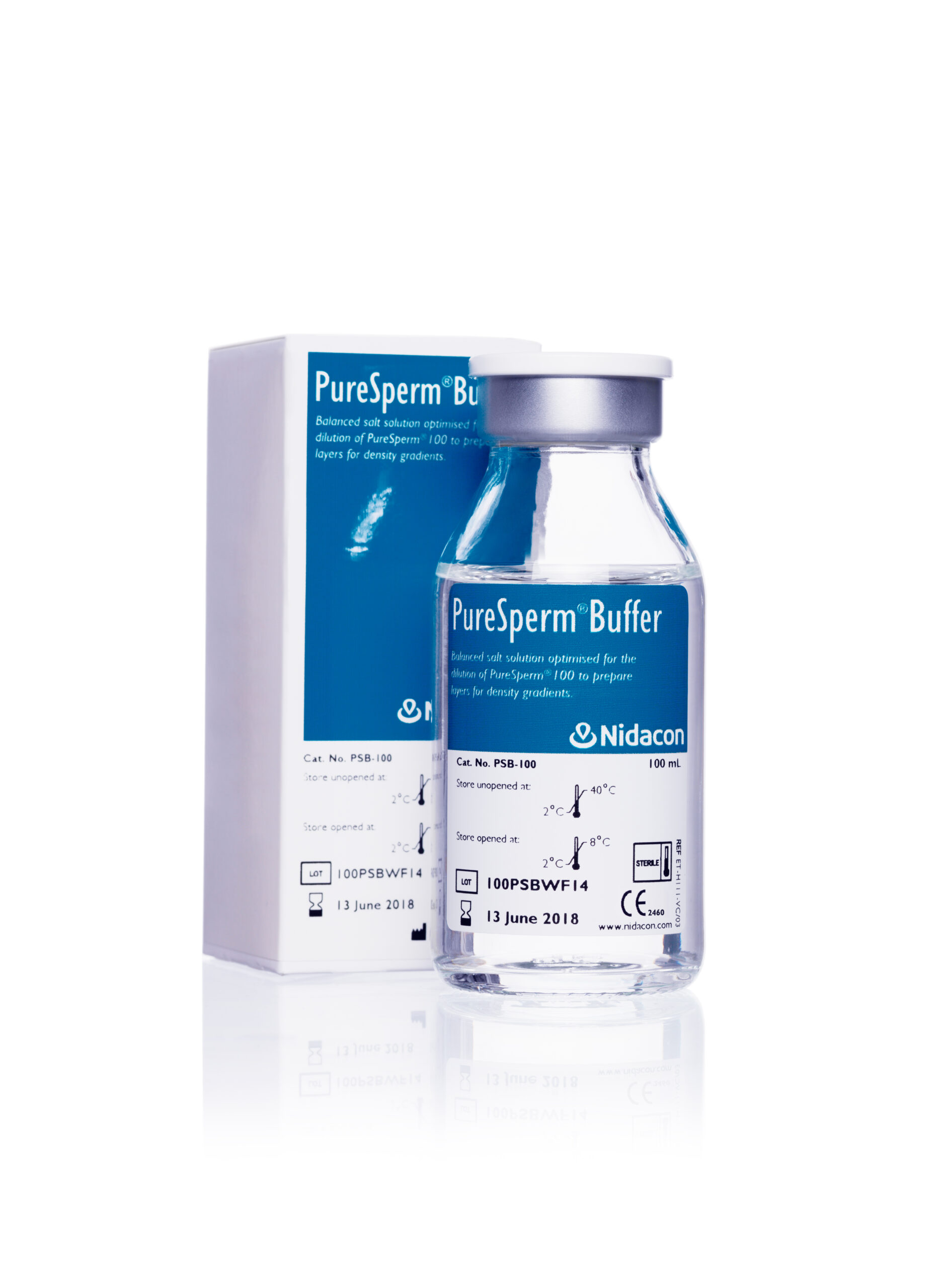
PureSperm Buffer – 100 mL
Dilution medium optimized for use with PureSperm 100.
PureSperm Buffer is designed specifically for two functions; first as a balanced salt solution for diluting PureSperm 100 to make up two layers of different densities for the gradient, and secondly, to reduce viscosity in the semen sample. The formula of PureSperm Buffer is optimized for maximum sperm survival and greatest yield during density gradient centrifugation.
Features
PureSperm Buffer is a sterile, isotonic, salt solution. It is optimised for the dilution of PureSperm 100 in the preparation of density gradients for the separation and purification of human sperm in ART. This gradient system effectively separates normal sperm from lymphocytes, epithelial cells, abnormal, immature and senescent sperm, cell debris, bacteria and seminal fluid.
Components
- Sodium chloride
- Sodium citrate
- Potassium chloride
- HEPES
- Calcium lactate
- EDTA
- Sodium pyruvate
- Glucose
- Purified water
Performance Characteristics
- pH: 7.4-7.8.
- Osmolality (mOsm/kg H2O): 300-310.
- Endotoxin levels: <1.0 EU/mL.
- Human sperm survival 18 hours after density gradient separation: >70%.
- Contents are tested by human sperm survival.
- Bottles and stoppers are M.E.A. tested.
Storage and Stability
- Store unopened bottles between 2 and 27ºC. Avoid temperatures above or below these values. When stored at these conditions, PureSperm Buffer has a shelf-life of 24 months from the date of production. The expiry date is shown on both bottles and cartons.
- Open and close bottles under aseptic conditions. After opening, store between 2 and 8ºC when not in use. The shelf-life described on the product label is only applicable when the product is stored according to manufacturer’s recommendations.
- No antibiotics, unstable additives, or preservatives have been added PureSperm Buffer.
Precautions and warnings
- Use aseptic procedures at all times.
- If available, use sealed centrifuge buckets during centrifugation to avoid the creation of aerosols.
- PureSperm Buffer does not present a fire or combustion hazard. A material safety data sheet is available from the distributor or manufacturer.
- Do not use any solution which shows evidence of bacterial contamination.
- Do not use contents if tamper-evident seal is broken.
- Do not re-use.
- Federal Law (USA) restricts this device to sale by or on the order of a physician.
- Please check for regulatory compliance governing the use of ART products in your country.
General recommendations
Dilute with PureSperm Buffer to make your gradient solutions.
- To make 10 mL of 90% PureSperm solution, mix 9 mL of PureSperm 100 with 1 mL of PureSperm Buffer.
- To make 10 mL of 80% PureSperm solution, mix 8 mL of PureSperm 100 with 2 mL of PureSperm Buffer.
- To make 10 mL of 40% PureSperm solution, mix 4 mL of PureSperm 100 with 6 mL of PureSperm Buffer.
You can adjust these ratios to make larger or smaller volumes, just keep the percentages consistent. The purpose of these gradients is to layer different densities for sperm separation, typically an upper (lower density, e.g., 40%) and lower (higher density, e.g., 80%) layer in a centrifuge tube.
Documents
References
Reference: Holmes, Björndahl, L., and Kvist, U. (2019). Possible factors influencing post‐ejaculatory changes of the osmolality of human semen in vitro. Andrologia, 51(11), e13443–n/a. https://doi.org/10.1111/and.13443
FAQ
How do I use PureSperm Buffer?
PureSperm Buffer is used to dilute PureSperm 100 to obtain the layers of different densities required for a discontinuous density gradient. PureSperm Buffer has been carefully formulated to give optimal results when used according to the manufacturer´s instructions. It is ready-to-use, no additives being required.
Why do I need to use PureSperm Buffer to dilute PureSperm 100?
A comparative analysis has shown that you will obtain a better yield of motile sperm by using PureSperm Buffer for diluting PureSperm than by using non-optimised products. Commercially available culture media, washing media, or salt solutions such as Earle’s ´Balanced Salt Solution have not been optimised for this purpose and also require other ingredients need to be added before use, thus increasing the cost.
Can PureSperm Buffer be used to dilute viscous samples?
PureSpermBuffer can be used to dilute viscous samples. The outcome of a sperm preparation can be affected by an increased osmolality in the ejaculate. A simple way to minimize the increase of osmolality is by early dilution of the ejaculate. PureSpermBuffer is the perfect buffer to be used for this purpose.
Why do I need to buy a separate product, such as PureSperm Buffer to dilute PureSperm 100? Could I use PureSperm Wash instead?
Yes, you can use PureSperm Wash to dilute PureSperm 100. However, a comparison in our laboratories has shown that you will obtain a better yield of motile sperm from using PureSperm Buffer which has been optimised for this purpose.
Should I equilibrate PureSperm Buffer before use?
If a bottle of PureSperm Buffer has been previously opened and then stored in the refrigerator, it should be brought up to room temperature before use to avoid cold-shocking the sperm. It is not necessary to equilibrate PureSperm Buffer in the CO² incubator before use.
Why use PureSperm Buffer
- Now, clinicians can select the density layers they want to use, in any combination.
- The same solution can be used to reduce viscosity in the semen sample.
Are there any antibiotics in PureSperm Buffer?
No, PureSperm Buffer does not contain antibiotics. Many commonly used antibiotics are toxic to sperm. Furthermore, antibiotics such as penicillin, have a very short half-life in solution. When used according to the manufacturer´s instructions, the PureSperm density gradient will enable an uncontaminated sperm preparation to be obtained from the semen sample.
Why is PureSperm Buffer good to use?
The prostate secretion contains large amounts of proteolytic enzymes (PSA) while the seminal vesicle secretion contains large amounts of proteins (semenogelin), peptides and prostaglandins which causes the gel formation at ejaculation when the secretions are mixed. After that the proteolytic enzymes start breaking down the large proteins and the gel will liquify. When you add a buffered salt solution you basically extend the solution and increase the space between the large proteins (semenogelin)and the complexes that they make-up break apart and the gel becomes liquified faster