
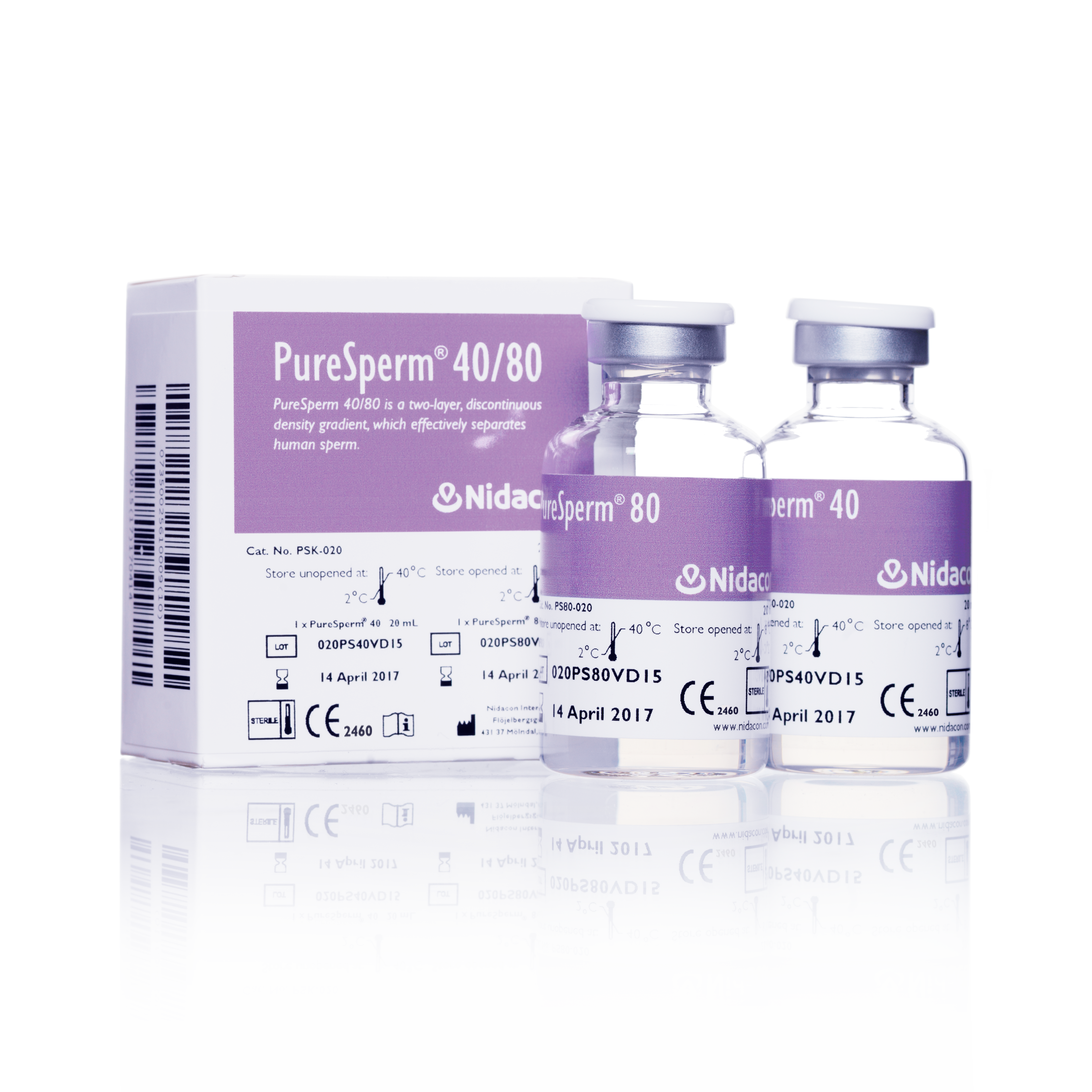
PureSperm 40/80 – 2×20 mL
Ready-diluted to save gradient preparation time.
PSK – 020, (PureSperm 40 and PureSperm 80) provides all the advantages of a PureSperm 100 gradient, with the added convenience that they come already diluted, saving preparation time. PureSperm 40, PureSperm 80 are formulated to minimize sudden pH and osmolarity changes during the transition of sperm from the semen sample to the fertilization medium. This helps avoid premature hyperactivation and improves fertilization potential.
Features
- PureSperm 40, PureSperm 80 are formulated to minimize sudden pH and osmolarity changes during the transition of sperm from a semen sample to the fertilization medium. This helps avoid premature hyperactivation and improves fertilization potential.
- PureSperm 40, PureSperm 80 maintain a pH of between 7.4 – 7.8 at room temperature (17 to 27°C) and when incubated at 37°, providing suitable conditions for good sperm motility, survival time, and fertilization potential.
- These preparations contain glucose as a usable energy substrate for normal cell metabolism and sperm function.
- The gradient enables motile sperm to be separated from debris, leukocytes, dead sperm and seminal plasma. In addition, damage to sperm DNA and structural molecules caused by reactive oxygen species (ROS) is minimized by the effective removal of immature sperm and lymphocytes. Bacteria, epithelial cells, and cell debris are also separated from the motile sperm, which can be difficult to achieve in polysucrose-based gradient preparations.
Components
- Silane-coated silica
- Potassium chloride
- Sodium chloride
- Purified water
- HEPES
- EDTA
- Glucose
- Sodium pyruvate
- Calcium chloride
Performance Characteristics
- pH: 7.4 – 7.8.
- Osmolality (mOsm/kg H2O): 300 – 310.
- Endotoxin transfer during treatment: <1.0 EU/mL.
- Sperm survival 18 hours after density gradient separation: >70%.
- Contents are tested by human sperm survival.
- Bottles and stoppers are M.E.A. tested.
Storage and Stability
- Store unopened bottles between 2 and 27ºC. Avoid temperatures above or below these values. When stored at these conditions, PSK – 020 (PureSperm 40 and PureSperm 80) have a shelf-life of 24 months from the date of production. The expiry date is shown on both bottles and cartons.
- Open and close bottles under aseptic conditions. After opening, store between 2 and 8ºC when not in use. The shelf-life described on the product label is only applicable when the product is stored according to manufacturer’s recommendations.
- No antibiotics, unstable additives, or preservatives have been added to PureSperm 40 and PureSperm 80.
Precautions and warnings
- When retrieving the sperm pellet, follow the instructions given in the pack insert to avoid inadvertent contamination.
- Use aseptic procedures at all times.
- If available, use sealed centrifuge buckets during centrifugation to avoid creation of aerosols.
- Clean accidental spills using a dampened cloth or paper. PureSperm 40, PureSperm 80 cause floors and benches to be extremely slippery.
- PureSperm 40, PureSperm 80 do not represent any kind of fire or combustion hazard. A material safety data sheet is available from the distributor or manufacturer(see nidacon.com).
- Do not use any solution which shows evidence of bacterial contamination.
- Do not use contents if tamper-evident seal is broken.
- Federal Law (USA) restricts this device to sale by or on the order of a physician.
- Please check for regulatory compliance governing the use of ART products in your country.
General recommendations
- All solutions should be brought 17-27°C before use to avoid the temperature fluctuations which are detrimental to sperm survival.
- Maintain aseptic techniques throughout sperm preparation procedures, including opening bottles only under sterile conditions and storing opened bottles at 2–8°C.
- Gradients should be layered immediately prior to use but the different density solutions of PureSperm can be prepared in advance, provided that they are stored at 4°C and brought up to room temperature before use.
- After gradient centrifugation, wash the recovered sperm pellet with PureSperm Wash.
Documents
SDS – View PDF
Product insert (latest version) – View PDF 40/80/90
For other languages, contact Nidacon
References
Comparative proteomic analysis of spermatozoa isolated by swim-up or density gradient centrifugation
Stefania Luppi1, Monica Martinelli1, Elisa Giacomini2, Elena Giolo1, Gabriella Zito2, Rodolfo C Garcia3† and Giuseppe Ricci12*†
Reproductive Biology and Endocrinology 2015, 13:36
Comparison of the DNA Fragmentation and the Sperm Parameters after Processing by the Density Gradient and the Swim up Methods
Iraj Amiri, Marzieh Ghorbani, Safora Heshmati
Journal of Clinical and Diagnostic Research. 2012 November, Vol-6(9): 1451-1453
Comparative study of the effects of three semen preparation media on semen analysis, DNA damage and protamine deficiency, and the correlation between DNA integrity and sperm parameters.
Charoenchai Chiamchanya, Nattpawit Kaewnoonual, Pachara Visutakul, Sirikul Manochantr and Jirattikan Chaiya.
Asian J Androl. 2010 Mar;12:271-277.
The use of two density gradient centrifugation techniques and the swim-up method to separate spermatozoa with chromatin and nuclear DNA anomalies.
Sakkas D, Manicardi GC, Tomlinson M, Mandrioli M, Bizzaro D, Bianchi PG, Bianchi
U.Hum Reprod. 2000 May;15(5):1112-6.
DNA fragmentation of spermatozoa and assisted reproduction technology.
Henkel R, Kierspel E, Hajimohammad M, Stalf T, Hoogendijk C, Mehnert C, Menkveld R, Schill WB, Kruger TF.
Reprod Biomed Online. 2003 Oct-Nov;7(4):477-84.
Bacterial contamination and sperm recovery after semen preparation by density gradient centrifugation using silane-coated silica particles at different g forces
C.M. Nicholson L. Abramsson, S.E. Holm and E. Bjurulf
Human Reproduction, Vol. 15, No. 3, 662-666, March 2000
Higher rates of recovery with PureSperm density gradient compared to ISolate
Agarwal, A. and Ranganathan, P.ESHRE 2001
A comparison of two density gradient preparations for sperm separation for medically assisted conception: Effect on recovery, clean-up, motility, and motion parameter.
J. A. Roudebush, et al.
Supplement of the 27th Annual Meeting of American Society of Andrology, 81 Seattle, USA (March/April 2002)
Comparison of Six Density Gradient Media for Selection of Cryopreserved Donor Spermatozoa
Nathalie Mousset-Siméon, Nathalie Rives, Lydie Masse, Florence Chevallier and Bertrand Mace
Journal of Andrology, Vol. 25, No. 6, November/December 2004
Semen processing by density gradient centrifugation is useful in selecting sperm with higher double-strand
DNA integrity
S. Brahem, M. Mehdi, H. Elghezal & A. Saad
Swim-up versus density gradients for sperm preparation in infertile couples undergoing intrauterine insemination: a randomized clinical trial
Tuyen N.D. Duong, et al.
Human Reproduction, 2025, 40(5), 788–795
FAQ
What diluent has been added to PureSperm100 to produce PureSperm 40, 80?
– PSK – 020 (PureSperm 40, and 80) are optimised products in their own right; they are not diluted PureSperm100. However, the colloid, salts and buffering capacity of these products have been optimised to provide the ideal 40% , 80% gradient layers.
Is there any human serum albumin in PureSperm 40, 80?
– Research in our laboratory showed that the yield of motile sperm recovered from the gradient was approximately the same, regardless of whether or not the gradient layers contained human serum albumin. Therefore, we have not included any protein in PureSperm 40, 80. The colloid in these products eliminates aggregation of sperm and reduces their sticking to the centrifuge tube. However, human serum albumin must be added to the “wash” solution, as provided in PureSperm®Wash.
Are antibiotics included in PureSperm 40, 80?
– No, PureSperm 40, 80 do not contain antibiotics, for the following reasons:
-
- The gradient will remove most, if not all, of the bacterial contamination present in the ejaculate, provided that the retrieval of the sperm pellet is carried out according to the instructions given in the package insert.
- Antibiotics commonly used in cell culture media can be toxic to sperm.
What is the buffer component of PureSperm 40, 80?
– PureSperm 40, 80 contains Hepes buffer to avoid fluctuations in pH which might be harmful to sperm.
What should be used for washing the sperm pellet after the PureSperm 40, 80 gradient centrifugations?
We recommend PureSperm Wash for washing the sperm pellet after gradient centrifugation. The ionic balance of PureSperm Wash lies between that of the gradient and commonly used fertilisation media and, therefore, will not cause premature hyperactivation of the sperm. PureSperm Wash is also ready-to-use and contains an appropriate level of human serum albumin.
What should be used for washing the sperm pellet after the PureSperm 40 and PureSperm 80 gradient centrifugation?
We recommend PureSperm Washfor washing the sperm pellet after gradient centrifugation. The ionic balance of PureSperm Wash lies between that of the gradient and commonly used fertilisation media and, therefore, will not cause premature hyperactivation of the sperm. PureSperm Wash is also ready-to-use and contains an appropriate level of human serum albumin.
Do we need to incubate PureSperm 40/80 in 6% CO², 37°C before use?
The most important to avoid is temperature fluctuations for the sperm. The ejaculate is approximately around room temperature or slightly higher. Therefore we recommend equilibrating PureSperm to room temperature, not more. The preparation is also done at room temperature and therefore the temperature is still maintained.